
Research Study
Children with cerebral palsy
Combined passive stretching and active movement rehabilitation of lower-limb impairments in children with cerebral palsy using a portable robot.
Participant Characteristics
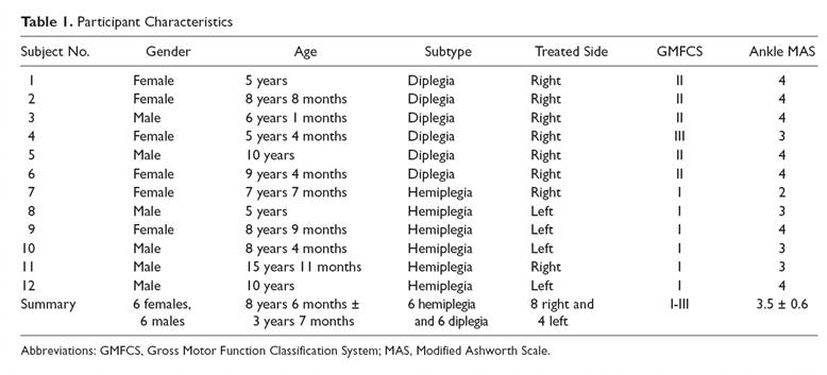
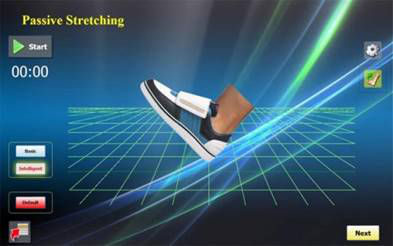
All participants completed 18 sessions of training with significant improvements:
Muscle Improvement
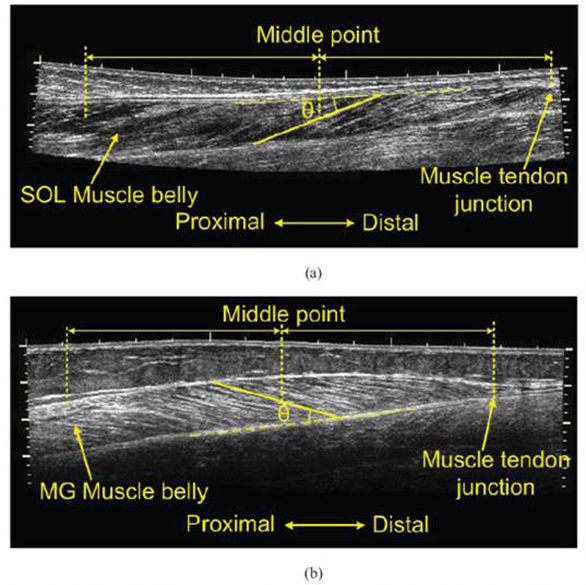
Measurable changes of Calf Muscle-Tendon Properties Induced by Stretching and Active Movement Training in Neurological Impairment
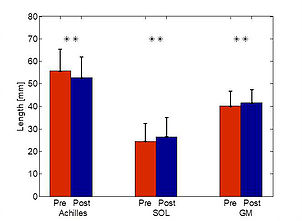
Muscle Length Improvement:
-
SOL fascicles from 24.8±8.2 to 26.8±8.6 mm (**)
-
GM fascicles from 40.2±6.6 to 41.5±5.9 mm (**)
-
Achilles tendon from 55.7±9.9 to 52.6±9.4 mm (**)
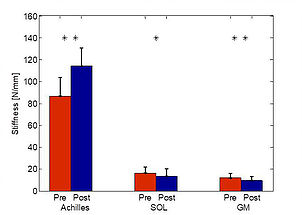
Muscle Stiffness Improvement
-
SOL fascicular stiffness from 16.6±5.2 to 13.8±6.3 N/mm (*)
-
GM fascicular stiffness from 12.2±3.8 to 9.6±3.6 N/mm (**)
-
Achilles tendon stiffness from 86.8±16.9 to 114.4±16.0 N/mm (**)
Research References
-
Combined passive stretching and active movement rehabilitation of lower-limb impairments in children with cerebral palsy using a portable robot. Neurorehabilitation and Neural Repair. 25, 378-385, 2011.
-
Changes of Calf Muscle-Tendon Properties Induced by Stretching and Active Movement Training in Neurological Impairment. Journal of Applied Physiology, 111(2), 435-442, 2011
-
Reliability of the intelligent stretching device for ankle stiffness measurements in healthy individuals. The Foot 20 (2010) 126–132
-
Does acute passive stretching increase muscle length in children with cerebral palsy? Clinical Biomechanics 28 (2013) 1061–1067
-
Responses to static stretching are dependent on stretch intensity and duration. Clin Physiol Funct Imaging. 2014 Aug 27. doi: 10.1111/cpf.12186.
-
(Sukal-Moulton, T., Clancy, T., Zhang, L.-Q., and Gaebler-Spira, D.)Clinical application of a robotic ankle training program for cerebral palsy compared to the research laboratory application: Does it translate to practice? Arch Phys Med Rehab. 95, 1433-1440, 2014.